
Four Years Too Late?
By Aaron Alexander Viltres
A Movement Etched In NFL History
As small as the number may seem, a lot can happen in four years. Every four years, we graduate. Every four years, we have the Olympics. And every four years, we vote for a president.
Four years ago, on August 26, 2016, the Black Lives Matter movement was heightened in the NFL when former quarterback Colin Kaepernick sat on the bench during the national anthem of a preseason game as a form of protest condemning police brutality. Fast forward to 2020, and the movement has been a focal point for the NFL this season.
“This whole period has enabled honest conversation that wouldn’t have happened otherwise, and it's unfortunate that it's taken all these deaths at the hands of people that are supposed to protect us,” said VP of Football Operations for Youth & High School Strategy for the NFL Roman Oben.
While this period has created room for open dialogue, it hasn’t been a conversation the NFL was willing to have back in 2016, which has raised the question of why now? The NFL and others, such as Donald Trump, quickly spun the protest into an un-American narrative even though the kneeling's inception came from a conversation between Kaepernick and former Green Beret, Nate Boyer.
Heading into the 2020 season, the NFL has taken a different stance on the handling of players protesting during the national anthem and has added new initiatives to its ‘Inspire Change’ program, which include allowing the name of victims to be placed on the back of a player’s helmet along with social justice slogans placed at the back of each endzone.
NFL commissioner Roger Goodell has also stated the players have his support and he wished “we had listened earlier” to Kaepernick when he began kneeling in 2016 when speaking to former linebacker Emmanuel Acho on his show "Uncomfortable Conversations with a Black Man.” "We have never disciplined a single player for anything with the national anthem and in violation of the policy," Goodell continued. "And I don't intend to. And I will support them."
Indeed, the NFL has never directly disciplined a player. However, Kaepernick was made an example of as he remains unemployed when the NFL had the opportunity to support him. Kaepernick, now 33, had his final workout with the NFL in 2019; however, whether he is in the league or not, the NFL is still dealing with the same issues concerning the anthem in 2020, which frankly shows just how effective the message was.

I think the NFL is just saving face, yeah you can play a black national anthem, but do something rooted to put a stop to the problem.... don’t do something as symbolism and go off to business as usual.

"They look at the physical reaction rather than the message behind it…. we put a knee down to raise attention, but we’re told it’s un-American, then what’s American? Give me the definition,” said Executive Director of the Kalief Browder Foundation Akeem Browder.
Browder, who ran for New York City mayor under the Green Party, is no stranger to the ongoing issues of police brutality and the criminal justice system. His brother, Kalief Browder, fell victim to that very system after being arrested in 2010, accused of stealing a backpack, and was detained on Rikers Island for three years. Two of those years were spent in solitary confinement but he was never convicted or charged with a crime.
The Kalief Browder Foundation has partnered with the NFL and was brought along by Jay-Z's Roc Nation, who executive produced his documentary “The Kalief Browder Story.” Following the NFL’s announcement to use the victims’ names on the back of players helmets they reached out to Browder to work out a contract to receive the rights to Kaliefs name.
This wasn’t the first time Akeem has done work in relation to the NFL.
“When Colin Kaepernick first came out with his protest, we inevitably got around to doing the Know Your Rights Camp,” Browder continued. “But before that, we had a meeting that included myself, Torrey Smith, Colin, and other players around the league to figure out what the camp should look like,” Browder said
The Know Your Rights Camp was founded by Kaepernick, which aims to raise awareness on higher education, how to appropriately interact with law enforcement, and self-empowerment for children of color.
Despite their partnership and the NFL’s efforts to show Black Lives Matter, Browder does not believe the NFL has put their best foot forward.
“I think the NFL is just saving face; yeah, you can play a black national anthem, but do something rooted to put a stop to the problem.... don’t do something as symbolism and go off to business as usual,” Browder added. “The NFL can use their funds to put more black people in administrative positions, putting one or two their just doesn’t seem genuine.”

The saying goes, “change starts at the top,” well, in a league where 70% of the players are black, it is astonishing that the diversity hasn’t become contagious on the leadership roles and management positions. There are currently three black head coaches in the NFL, Brian Flores, Anthony Lynn, and Mike Tomlin who, has the Steelers now at 11-1, surpassed Tony Dungy as the winningest black head coach in NFL history and tied the NFL record with 14th straight non-losing season this year. There are also only two black general managers in the NFL, Andrew Berry, and Chris Grier.
This brings into question the effectiveness of the Rooney Rule, a rule adopted by the NFL in 2003, which requires every team with a head coaching vacancy to interview at least one or more diverse candidates. The rule has been modified numerous times, like in 2009, where the Rooney Rule was expanded to include general manager jobs and equivalent front-office positions. Again, in 2018, it forced teams to interview for vacancies outside of their club. With all these modifications, there is little to show for a rule that has been around for 17 years.
“The Rooney Rule enabled there to be a Mike Tomlin and Herman Edwards, but all we can control is the process. It's up to the owners, but you have to get the candidates in front of the hiring managers,” Oben added. “You just saw the Washington Football Team hire the first black team president. In a good way, he’s the first black team president; in a bad way, it’s 2020, and we’re talking about the first black team president.”
All isn’t trending in a downwards direction, though. To kick off the season this year, there were ten black starting quarterbacks, the most in NFL history. In addition to that, November 23, 2020, will mark the first time the NFL has an all-black officiating crew to work a game, and as Oben stated, the Washington Football team hired the first black team president.
During an interview with the Manager of Football Operations at the NFL, Daniel Van Norten, delves into what goes on behind the scenes at the NFL offices.
"I'm a part of the Black Engagement Network (BEN) program, which focuses on the acquisition, development, and promotion of black employees at the office," said Van Norten. Van Norten added, "with acquisition, we are excited about our partnership with the National Black MBA."
The National Black MBA Association is a non-profit organization dedicated to the enhancement and development of educational and empowerment for African Americans. Van Norten said due to Covid-19 outbreak the acquisition aspect has been halted but hopes to pick back up soon so more black employees can make an impact behind the scenes.
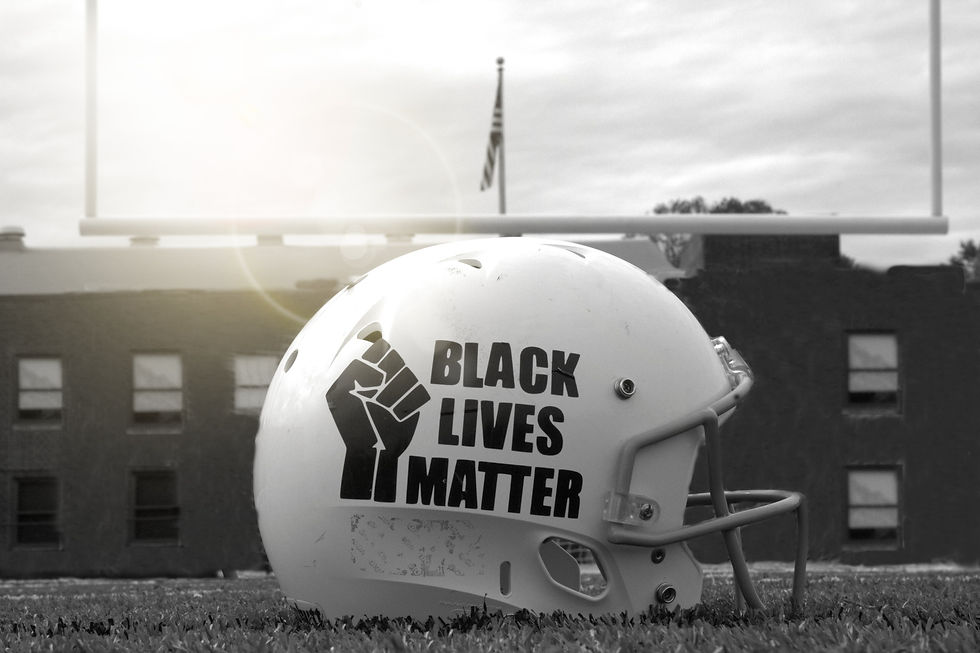
A Black Lives Matter helmet at Mount St. Michael Academy. Photo by Aaron Alexander Viltres
The NBA, like the NFL, is predominately made up of black players, with 70% making up the NFL and 81% in the NBA as of 2020, but why has the NBA felt like the more progressive league over the years? Both have dealt with their fair share of political undertones, but how they have responded has left the leagues on opposite sides of the spectrum. The Golden State Warriors were uninvited to the White House by Trump in 2017, which caused responses from both Head Coach Steve Kerr and superstar Lebron James.
“Not surprised. He was going to break up with us before we could break up with him,” said Kerr.
James’s response was much more fiery, stating, “U bum @StephenCurry30 already said he ain't going! So, therefore, ain't no invite. Going to the White House was a great honor until you showed up!”
Neither Kerr nor James were reprimanded for their responses, and in fact, no player has been punished by the NBA for protesting or kneeling.
The Philadelphia Eagles experienced the same treatment in 2018 when Trump canceled their White House visit after a small number of players committed to attending. “Staying in the Locker Room for the playing of our National Anthem is as disrespectful to our country as kneeling. Sorry,” Trump tweeted.
The statement turned out to be hypocritical as a few months later the NFL announced a new rule that Trump praised, which allows players to wait in the locker room during the anthem, but says those on the field must "stand and show respect for the flag and the Anthem" or risk a fine.
“I think I take it a little more personal because I played in the NFL when I hear the NBA did this and that, well, look at how they are structured. You’re talking about moving the direction of 100 guys that would listen to Lebron and Chris Paul versus 1,800 guys,” said Oben.
The structure of both leagues is vastly different, as Oben alluded to. For one, the NFL is more invested in the branding of teams more than the players themselves, which makes them disposable, as in the case with Kaepernick. The logo is a shield coated in the colors of the American flag, while the NBA logo is a silhouette of former point guard Jerry West who now holds an executive position for the LA Clippers. Player contracts in the NFL are not fully guaranteed, making it easier to cut them as opposed to the NBA.
Before the NFL’s announcement to allow the placement of the names of victims on player helmets and include slogans at the back of the end zone, the NBA had already decided to place Black Lives Matter on all three courts as well as allowing players the freedom to wear the name of a victim or a slogan on their jersey.

“In taking things the NBA did, the beauty is that a lot of folks collaborate, and we have one common goal to end racism. I’m a part of the Black Engagement Network, and we do communicate with our counterparts at the NBA,” said Manager of Football Operations at the NFL, Daniel Van Norten.
The premier position in the NFL is the quarterback, which is often occupied by a white player. In 2016 Drew Brees emphasized he had no issue with Kaepernick's fight against racial injustice but was adamantly against his method of protest, stating the flag is “sacred.” In an interview with Yahoo earlier this year, Brees doubled down on those comments saying he doesn’t agree with anyone who disrespects the flag by kneeling during the anthem.
Brees, a few days later, apologized for his comments after receiving enormous backlash from fans, peers, and teammates around the league. “I recognize that I should do less talking and more listening...and when the black community is talking about their pain, we all need to listen,” said Brees.
While many players over the years have voiced that the protest isn’t directed at the flag, it shouldn’t come as a surprise that the NFL and some players within the league would take issue with it. The structure of the sport is militant in itself as players take to the battlefield with helmets and armor on, covered in war paint, with some players having no distinguishable identity outside of the logo and colors of the team they represent. Combine that with the money the military gives the NFL, and you have yourself a recipe for ultimate patriotism within the league. For instance, a report based on public records published in May of 2015 showed that the Department of Defense had paid close to six million dollars in taxpayer money to the NFL, which was split between 14 teams to market acts of patriotism.
“I personally don’t like it, if people have a political stance or something to say that’s fine, but you come to sports to get away from all of that,” said an African American NYPD officer who wished to remain anonymous.
The NYPD officer also said that Kaepernick was blackballed, but believes he put himself in that position. “Kaepernick was absolutely blackballed, but if you look at his situation, he gave them the ability to do so because he was a backup QB on the worst team in the NFL at the time.”
So had he done it around the time of his Super Bowl run, do you think the outcome would’ve been different?
“Absolutely! He had a much better stock,” said the NYPD officer.
One generation paves the way for the next, and as the kneeling during the anthem has become etched in the NFL’s history, it appears the younger generation of football players are following suit. Due to the Covid-19 outbreak earlier this year that continues to haunt the nation, many high schools and leagues throughout New York had their seasons canceled or pushed until the spring.
“We are literally one of the only teams playing in New York right now. We’ve traveled to Maine, Connecticut, and other places just to get games in,” said linebacker for the New York City Patriots Keion Barran.
The New York City Patriots are a semi-pro football team that has been able to get around the football restrictions due to Covid by traveling to other states.
“We played our first game in Maine, and as a team, we collectively decided out of respect for the fallen victims we would all take a knee during the anthem,” Barran added. “That was the only time we kneeled, but throughout the season, we continue to wear wristbands and cleats that have phrases to show support.”
At the high school level, Mount St. Michael Academy Head Coach Mario Valentini is expecting a shortened season to kick off sometime in the spring, but during the height of the BLM movement throughout the nation decided to issue an email to his team. “I was supportive of all our kids and wanted to let them know we’re in this together,” said Valentini
High schools such as Bartram Trail High School in St. Johns County, Florida, had players take part in kneeling early in September, which spurred mixed feelings throughout the area, but athletic director Ben Windle said he supports the athlete's 1st amendment right to protest. A similar issue transpired in Baton Rouge, where the Liberty High School principal was fired over a rant over players kneeling during the anthem.
When asked how would you respond to a player wanting to kneel during the anthem, Valentini responded with, “We would first have an open conversation and figure out what is the end game, what are you trying to accomplish. Valentini added, “football is different because people are accepting of each other if everyone were as accepting of each other as we are on the field we wouldn’t have this problem.”